
Anti-Aging Serum: Why Fine Lines Look Worse at Night (And What That’s Actually Telling You)
There is a particular moment that nobody warns you about.
It is late. You have washed your face, you are standing under that bathroom light that has never once flattered anybody, and you notice something that was not there this morning — a line beside your eye, or two of them near your mouth, fine and faint and definitely new. Your stomach drops a little. You lean closer. You make the face everyone makes.
And then the strangest thing happens. You wake up eight hours later, walk back into the same bathroom, and they have softened. Not vanished. But softened, clearly, visibly, as though someone had quietly smoothed them while you slept.
Most people see that and feel relief. They should feel curiosity instead — because that disappearing act is your skin handing you a piece of information, free of charge, and it tells you precisely what kind of ageing you are actually dealing with. Which means it also tells you what will work.
Two Kinds of Lines, and Only One Is About Age
This distinction is the most useful thing in this entire article, so here it is plainly.
Dehydration lines are shallow, fine, and often arranged in little criss-cross patterns. They show up when your skin is low on water, which is why they are worst at night after a long dry day, and better in the morning after hours of rest in still air. Press a damp fingertip near one and watch it plump. These lines are not permanent. They are a water-level reading.
Structural lines are the other sort. These sit in the same place regardless of the hour, deepen slowly over years, and trace the expressions you have made most often — which is why laugh lines land where laughter lands. These involve real change in the collagen and elastin underneath, and they do not plump away overnight.
Most faces, past the late twenties, carry both. Here is the thing people get wrong: they attack the structural ones with aggressive treatments and completely ignore the dehydration ones, when the dehydration lines are the ones that would respond fastest and make the biggest visible difference soonest.
If your lines look worse at night and better by morning, you have a water problem wearing an ageing costume. Fix the water, and a surprising amount of what you were mourning simply leaves.
So Why Not Just Drink More Water and Call It Done
Because — and this is where a lot of well-meant advice falls apart — your skin is the last organ in the queue.
Drink a litre and your body distributes it by priority. Kidneys, brain, blood volume, muscles. Skin is at the back of the line, and the water that does arrive has to travel outward from your bloodstream to the surface, where it immediately begins evaporating into the air. That outward loss has a name, transepidermal water loss, and it never stops. It just happens faster in dry air, in air-conditioning, in wind, in heat.
So hydration from inside matters, genuinely, but it cannot hold water at the surface. Something has to be on the skin, catching that water and keeping it where it can plump a line.
Now Here’s Where It Gets Complicated
And just as that starts to feel manageable, the structural side of ageing turns out to run on a process almost nobody has heard of.
You know about collagen declining with age, and about UV breaking it down. Both true. But there is a third mechanism, and it is quietly central: glycation.
Here is what happens. Sugar molecules circulating in your body bump into proteins and stick to them. Not through any orderly enzymatic process — just chemistry, slow and unsupervised. When sugar attaches to a collagen fibre, it changes it. The fibre stiffens. It loses its spring. And then stiffened fibres start bonding to their neighbours, cross-linking into a rigid lattice where there used to be flexible, bouncy tissue.
The end products of this process have a name that tells you everything: advanced glycation end-products. The acronym is AGEs.
Think about what that means for a moment. Collagen that has been glycated is not depleted — it is still there, still present in the tissue. It has simply gone stiff. It is like the difference between a fresh rubber band and one that has been sitting in a drawer for four years: same material, same amount of it, but the elasticity has gone out of it, and it no longer snaps back into shape.
This is why skin that is well-hydrated and well-protected can still begin to look slack. The water is there. The collagen is there. The bounce is what left — and no amount of moisture alone brings bounce back, because moisture addresses the water in the tissue, not the stiffness of the fibres running through it.
So now you have two separate problems, with two separate mechanisms, and treating one does nothing for the other. Water for the dehydration lines. Something else entirely for the glycation.
Which Is Why This Serum Has Two Jobs
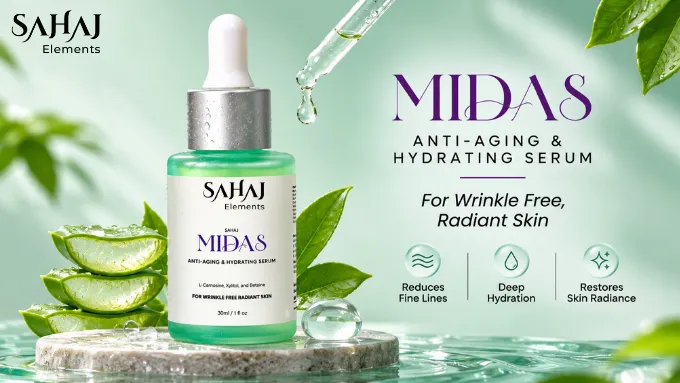
The SAHAJ MIDAS Anti-Aging & Hydrating Serum is built around that exact split, and the name of the product is honest about it — anti-aging and hydrating. Two words, two mechanisms, deliberately.
For the glycation side: L-Carnosine. This is a dipeptide — two amino acids joined together — and it is one of the better-studied anti-glycation agents available to skincare. Its approach is elegant: it offers itself to the sugar molecules as an alternative target. Sugar that latches onto carnosine is sugar that did not latch onto your collagen. It also carries antioxidant activity, which means it helps with the environmental-stress side of ageing at the same time. One ingredient standing between your structural proteins and the slow stiffening that dulls their spring.
For the water side: xylitol and betaine. Xylitol is a humectant that draws moisture in and holds it, and it has a useful second property — it supports the skin’s own moisture-regulating machinery rather than merely sitting there wet. Betaine is an osmolyte, which means it helps your skin cells manage their internal water balance and stay comfortable when conditions outside turn dry. Together they are not a one-night plumping trick. They are a help with holding water over time.
So: carnosine for the lines that do not move, xylitol and betaine for the lines that do. The serum is addressing both columns of the problem at once, which is why a formula this light can shift something as unglamorous as elasticity.
The Part Nobody Puts on the Label
Four things, learned the hard way.
Neck included. Always. The skin there is thinner, gets less attention, and ages faster — and a smooth face above a crepey neck fools nobody. The directions say face and neck for a reason.
Night is the better slot. Your skin’s repair activity runs higher overnight, and MIDAS has no sun-sensitivity concerns to work around. Cleanse with the SAHAJ Absolute Hydrating Coconut Milk Face Wash, apply the serum, seal it in, sleep.
Seal it or lose it. This bears repeating because it is the single most common mistake in anti-ageing routines: a humectant serum with nothing over it will, in dry air, pull water from your deeper skin layers and surrender it to the atmosphere. You have to put a lid on it. The SAHAJ Absolute Multi Purpose Cream is formulated as that lid — betaine and xylitol again for continuity, plus aloe vera, carrot seed, and niacinamide for tone.
Be patient in the right way. Hydration lines look better within days; some people notice overnight. Firmness and elasticity are a twelve-week conversation, because you are waiting on collagen behaviour, and collagen keeps its own calendar. Judge the first at two weeks. Judge the second at three months, in the same light, at the same time of day.
And if dullness sits alongside the fine lines — which it very often does, since both trace back to the same slowed cell turnover — alternate the SAHAJ ZIVA Vitamin C Serum – Glow Booster in on your morning routine. Vitamin C in the day, MIDAS at night. They are not competing; they are covering different shifts.
Your Anti-Ageing Routine, in 60 Seconds
Morning
- Coconut Milk Face Wash
- ZIVA Vitamin C Serum — optional, if tone is also a concern
- Absolute Multi Purpose Cream
- Sunscreen — the most effective anti-ageing step there is, and it costs you ten seconds
Night
- Coconut Milk Face Wash
- MIDAS Anti-Aging & Hydrating Serum — face and neck
- Absolute Multi Purpose Cream
Three steps at night. Four in the morning. No ten-product shelf, no acid you have to build a tolerance to, nothing you will abandon by February.
Tonight, when you are back under that unkind light, look at the lines again — but look at them as information rather than a verdict. The ones that will be gone by morning are a water problem. The ones that will still be there are a bounce problem.
You can work on both. You just have to know which is which.
Browse the serum collection, see the gel and cream range, check current offers, or tell us what your skin is doing and we will point you to the right starting place.