
Multi Purpose Face Cream: Why Your Serum Is Disappearing Before It Works
Here is a small experiment you can run tonight, and it costs you nothing.
Wash your face. Apply your serum — whichever one you have invested in, whichever one has the ingredient you read about and believed in. Then stop. Do not apply anything over it. Go and do something else for twenty minutes, then come back to the mirror and touch your cheek.
Dry. Not just absorbed — dry, and quite possibly a little tight, as though nothing had been applied at all.
Most people interpret that as absorption. It is absorption’s less helpful cousin. A significant part of what you applied has evaporated off your face and into the room, and it did not leave empty-handed. It took your actives with it.
That is the quiet leak in almost every skincare routine. People spend carefully on serums and then skip the one inexpensive step whose entire job is to keep the serum from leaving.
What a Serum Actually Is
A serum is, mechanically speaking, a delivery vehicle. Active ingredients — vitamin C, acids, peptides, humectants — carried in a base that is mostly water and lightweight solvents, designed to be thin so it absorbs fast and penetrates well.
That thinness is a genuine strength. It is also a structural weakness, because a mostly-water product on the surface of your skin is subject to the same physics as any other water left out in the air. It evaporates. In a warm room, in dry air-conditioning, in the kind of heat we get here for most of the year, it evaporates briskly.
Some of your serum gets in. Some of it goes up. The ratio between those two outcomes is largely decided by what you do in the ninety seconds after you apply it.
Which Brings Us to the Leak Nobody Mentions
There is a second, continuous water loss happening underneath all of this, and it has a name: transepidermal water loss, or TEWL.
Your skin is roughly sixty-four percent water, and that water is constantly migrating outward from the deeper, wetter layers toward the dry air at the surface, where it escapes. This is normal and unstoppable. What is not fixed is the rate — and the rate is controlled by the quality of your skin barrier, the lipid-and-cell structure at the very top that acts as the seal.
A good barrier slows the loss. A compromised barrier lets it run.
So you have two leaks at once. The serum escaping upward from the surface, and your skin’s own water escaping outward from below. A moisturiser’s real job — its only indispensable job — is to slow both of them down.
Now Here’s Where It Gets Complicated
Fine, you think. Apply the hydrating thing. Any hydrating thing. Hydration is hydration.
It is not, and this is where a genuinely counterintuitive problem appears.
Moisturising ingredients come in three distinct classes, and they do not do the same work:
Humectants — hyaluronic acid, glycerin, betaine, xylitol — attract water and hold it. They are magnets.
Emollients — lighter oils and esters — fill the gaps between skin cells, which is what makes skin feel smooth and soft rather than rough.
Occlusives — heavier lipids and butters — form a physical film on the surface that blocks evaporation outright. They are the lid.
Now, the problem. A humectant is a magnet for water, but it is not a thoughtful magnet. It pulls moisture from wherever moisture is available. In humid air, it draws from the atmosphere, which is lovely. But in dry air — a cool-dry December morning in Gujarat, a bedroom with the AC running all night, a long flight — there is no water in the air to take. So the humectant pulls from the only other reservoir available: the deeper layers of your own skin. It hauls water upward to the surface, where the open air promptly takes it away.
Which means that a pure humectant serum, applied and left unsealed in dry conditions, can leave your skin drier than before you applied it. The product did exactly what it was designed to do. The conditions made that a net loss.
Hyaluronic acid is the famous casualty of this. Enormous numbers of people have tried a hyaluronic serum, found their skin felt tight and papery an hour later, and concluded it did not suit them. It suited them fine. It was never sealed.
So now the knot is properly tied. Serums are mostly water, so they evaporate. Their best hydrating ingredients are humectants, which need an external source of water to work. And without something over the top, those humectants will take the water out of you and hand it to the room. The more you spend on serum, the more there is to lose.
One lid fixes all of it.
And This Lid Does More Than Seal
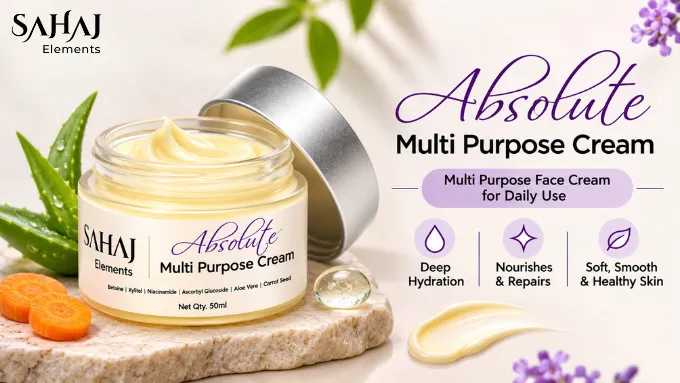
The SAHAJ Absolute Multi Purpose Cream is built for this position in the routine, and the reason it is worth the step is that it is not a passive lid. It carries all three moisturising classes and actives of its own.
For holding water:
- Betaine — a humectant and osmolyte, helping skin cells manage internal water balance and stay comfortable as conditions outside change
- Xylitol — attracts and retains moisture, and supports the barrier that governs your TEWL rate, so it helps the seal as well as the fill
For comfort:
- Aloe vera — soothing and hydrating, and the reason this cream sits well on skin that has had a long day, a lot of sun, or an acid the night before
For actually improving the skin, not merely covering it:
- Niacinamide (vitamin B3) — one of the most versatile ingredients in skincare, associated with improvement in the look of uneven tone, visible redness and surface texture, and with supporting barrier function. That last point matters enormously here: niacinamide is not just sitting on top slowing your water loss, it is helping the structure that controls water loss in the first place.
- Ascorbyl glucoside — the stable vitamin C derivative, for brighter, more even-looking skin
- Carrot seed — antioxidant support against the environmental stress your face absorbs all day
Read that list again with the leak in mind. Humectants to hold water, emollient comfort so skin feels soft rather than merely occluded, barrier support to slow the deeper loss, and three active ingredients working on tone and texture while they do it.
That is what makes it reasonable to call this a multi purpose cream. Not marketing shorthand — it genuinely works in several positions at once. It seals your serum, hydrates on its own, brightens, and supports the barrier, which is why it closes three different routines on this site: the brightening routine after the SAHAJ ZIVA Vitamin C Serum – Glow Booster, the anti-ageing routine after the SAHAJ MIDAS Anti-Aging & Hydrating Serum, and the dry-skin routine after the SAHAJ Absolute Hydrating Coconut Milk Face Wash.
One cream, three routines, morning and night.
The Part Nobody Puts on the Label
Apply it while your skin is still slightly damp. This is the single highest-return tip in this article and it costs nothing. Damp skin gives the humectants surface water to grab, and the cream then locks that water in rather than hunting for it in your deeper layers. Serum, then cream within a minute or two — do not let your face dry out in between.
Face and neck, every time. Neck skin is thinner, gets less care, and shows age sooner. It takes four extra seconds.
Upward and outward, lightly. You are not massaging it in with force. Even pressure, gentle strokes, around the eye area rather than onto it.
Both ends of the day. Overnight is when water loss runs highest, with hours of still, dry air and no reapplication. Morning is when you need the base under sunscreen. It belongs in both routines.
If you are oily or breaking out, zone it. A cream of this type is right for normal, dry, combination and mature skin. If you are oily through the T-zone, use the SAHAJ AURA Acne Control Gel there and this cream on the drier areas — there is no rule that your whole face has to be treated identically, and most faces are not uniform anyway.
And start simple if you are starting from nothing. If you own no skincare at all, a cleanser and this cream are a complete, functioning routine. Two products. Serums are the upgrade, not the foundation. We made that case properly in why skin care is important, and it remains the honest answer to “where do I begin.”
Your Routine, in 60 Seconds
Morning
- Cleanse — Essential Face Wash for normal and combination skin, Coconut Milk Face Wash if you lean dry
- Serum — optional
- Absolute Multi Purpose Cream — onto slightly damp skin, face and neck
- Sunscreen
Night
- Cleanse
- Serum — optional
- Absolute Multi Purpose Cream
Run the experiment again in a week, but change one thing: apply the cream within a minute of the serum, while your face is still a little damp. Then touch your cheek twenty minutes later.
It will feel like a different face. It is the same face — you simply stopped letting the good part evaporate.
Browse the gel and cream range, the full skincare collection, combo packs, current offers, or write to us — tell us what your skin is like and we will keep the answer to two products.