
Acne Serum: Why You’re Treating the Wrong Pimple (The Three-Week Head Start)
It arrives on the worst possible morning.
There is something you have to be at — an interview, a function, a shoot, a wedding where four hundred people will look at your face — and there it is, red and raised and perfectly centred, as though it had checked your calendar first. So you do what any reasonable person does. You attack it. Spot cream, maybe something stronger, maybe something a cousin recommended. You press it, you dab at it, you give it everything you have.
And three days later, once that one has finally started to retreat, a new one shows up two centimetres to the left.
You have probably been doing this for years. Spot, attack, retreat, repeat — a war fought one pimple at a time, always reacting, never ahead. And the reason it never ends is not that you are undisciplined or unlucky.
It is that the pimple you can see is already old news. By the time it surfaced, it had been forming for two to three weeks. You are not fighting it. You are attending its arrival ceremony.
What Is Actually Happening Inside a Pore
To get ahead of this, you have to know what the thing is before it becomes visible.
Every pore on your face is a tiny tube with an oil gland at the bottom and a hair follicle running through it. Oil, called sebum, is produced down there and travels up and out. Meanwhile, the walls of that tube are shedding dead cells, the same way the rest of your skin does. On a good day, oil flows out, dead cells float out with it, and you never think about any of it.
A breakout begins when that traffic jams.
Dead cells inside the pore wall start shedding too fast — or sticking together instead of releasing — and they plug the opening. Sebum keeps being produced below the plug, because nobody told the gland to stop, so pressure builds in a sealed tube. This plugged, pressurised, still-invisible pore has a name: a microcomedone. It is microscopic. You cannot see it, you cannot feel it, and it is the actual beginning of every single pimple you have ever had.
Then the biology turns. Inside that sealed pore is a warm, oily, oxygen-free pocket — which happens to be the ideal environment for C. acnes, a bacterium that lives harmlessly on everyone’s skin and becomes a problem only when it gets a chamber like this to multiply in. It blooms. Your immune system notices the bloom and sends inflammatory cells. The pore wall, now stretched thin, ruptures into the surrounding tissue.
That rupture is the moment you finally see something. Red, swollen, sore. The visible pimple is the last act of a play that has been running for twenty days.
Which Explains Why Spot Treatment Keeps Failing You
Look at what spot treatment is actually doing with that timeline in view.
You are applying something to a pore that has already ruptured. The plug has failed, the bacteria have bloomed, the inflammation has fired. At best you shorten the healing. You may well calm the redness, and that is worth something on the morning of an interview.
But across the rest of your face, in pores you are not touching because nothing is visible there yet, dozens of microcomedones are quietly at week one, week two, week three. You are not treating acne. You are managing its most recent graduate, while the next class moves through the system completely undisturbed.
This is why the cycle feels endless. It is endless, by design — your design.
Now Here’s Where It Gets Complicated
So the answer seems obvious: stop spot-treating, treat the whole face, get something strong across every pore. Dry the oil out everywhere.
And this is exactly where most people make their skin significantly worse — because the instinct to strip is the single most counterproductive instinct in acne care.
Here is the trap. Your skin’s outer layer holds a barrier made of lipids — oils, ceramides, fatty acids — that keeps water in and irritants out. Harsh, drying, oil-stripping products damage it. And when that barrier is damaged, two things happen at once, both of them bad for you.
First, water escapes faster. Your skin reads that loss as an emergency and signals the oil glands to compensate, which they do enthusiastically. You strip the oil, and your skin produces more oil than it did before you started. People live in this loop for years, washing more and more aggressively, getting oilier and oilier, concluding that their skin is simply “very oily” when in fact their skin is simply very injured.
Second, a damaged barrier is an inflamed barrier. And inflammation is not a side effect of acne — it is a driver of it. Inflamed skin sheds its pore-lining cells abnormally, which is how plugs form in the first place. So the stripping that was meant to prevent breakouts is actively manufacturing the conditions for the next round.
There is the knot. Doing nothing to the whole face leaves microcomedones free to mature. Doing something harsh to the whole face creates more of them. The pimple you can see is three weeks old, the ones you cannot see are coming, and both of your obvious options fail.
So what actually works on a pore you cannot even find?
You Go Inside the Pore, and You Go Gently
The way out is not force. It is access — getting a mild exfoliating action down inside the pore itself, where plugs form, before a plug ever becomes a problem. And that requires a specific property: the active has to be oil-soluble, because the inside of a pore is lined with oil, and a water-loving ingredient will simply slide over the top and never get in.
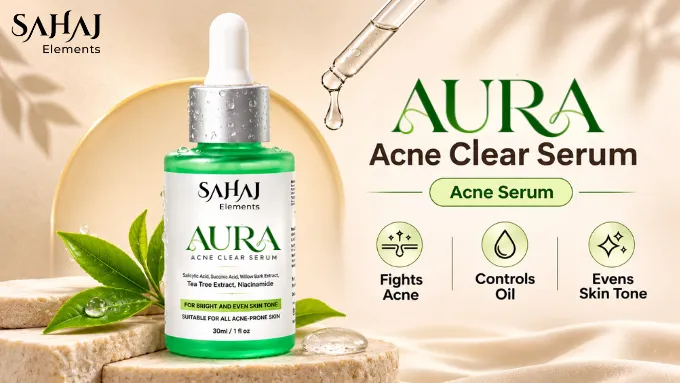
That is the whole principle behind the SAHAJ AURA Acne Clear Serum, and behind its lead active.
Salicylic acid is a beta-hydroxy acid, and it is oil-soluble — the reason it has been the backbone of acne care for decades. It travels down into the pore, loosens the bonds holding dead cells to each other and to the pore wall, and lets the plug clear before pressure, bacteria and rupture ever get their turn. It is working on week-one microcomedones you will never know existed, which is precisely the point. It also carries anti-inflammatory activity, which helps on the redness side.
Succinic acid works alongside it, contributing to the formula’s clarifying action and bringing its own calming character to a formula that could otherwise feel one-note.
Then the serum does something that genuinely distinguishes it, and it is the part that addresses the stripping trap directly — it includes botanicals chosen for calm rather than attack:
- Willow bark extract, a traditional source of salicylates, extending the gentle exfoliating action in a softer, plant-derived form
- Manjistha, long used in Ayurvedic practice for the appearance of skin clarity and evenness
- Lodhra, another classical botanical with a long history in formulations aimed at congested, blemish-prone skin
That combination is the answer to the knot. Exfoliating action where plugs actually form, with calming botanicals so you are not trading today’s breakout for tomorrow’s compromised barrier. Not force. Access.
The Part Nobody Puts on the Label
Five things, and the fifth is the one that decides whether this works for you.
Go slow at the start. This formula contains exfoliating acids. Every other night for the first two weeks, then build up. Skin that is introduced gently to acids keeps tolerating them; skin that is rushed rebels, and then you quit.
Whole area, not the spot. This is the entire thesis. Apply across the zone where you break out — the full T-zone, the full jaw, wherever your pattern lives — not onto the one pimple you can see. You are working on invisible pores. Treat them as though they are there, because they are.
Cleanse first, properly. Use the SAHAJ AURA Anti Acne Face Wash before the serum, so the actives meet skin rather than the day’s oil and sunscreen.
Moisturise after. Yes, even oily skin. Especially oily skin. Everything in the section above explains why. Follow with the SAHAJ AURA Acne Control Gel — a lightweight, water-based gel built for exactly this, so you get hydration without heaviness and without feeding the shine.
Sunscreen, every morning, without exception. Acids make skin more sun-sensitive, and post-breakout marks darken dramatically with UV exposure. Half the “scarring” people mourn is pigmentation that sunscreen would have kept pale.
And then the hardest instruction of all: wait, and understand what you are waiting for.
Give this eight to twelve weeks. Not because the serum is slow, but because of the three-week head start. Every pimple that appears in your first fortnight was already in the pipeline before you started — it was always going to arrive, and nothing you apply now will stop it. You are working on the pores that would have broken out in week five, week seven, week ten. The results arrive on acne’s schedule, not yours.
Most people quit in week three, right when it is beginning to work, convinced it has failed. Do not be most people.
Your Acne Routine, in 60 Seconds
Morning
- AURA Anti Acne Face Wash
- AURA Acne Control Gel
- Sunscreen — broad spectrum, non-negotiable with acids in your routine
Night
- AURA Anti Acne Face Wash
- AURA Acne Clear Serum — across the whole breakout zone, every other night to start
- AURA Acne Control Gel
Three products. Three steps. If your skin runs dry in patches alongside the breakouts — which is more common than people admit — swap the gel for the SAHAJ Absolute Multi Purpose Cream on the dry areas only. And if you are not certain your cleanser is right for you in the first place, our guide on choosing the right face wash for your skin type settles it quickly.
Stop fighting the pimple on your chin. It was decided weeks ago, and it is leaving anyway.
Fight the ones that have not arrived yet. Those are the only ones you can still win.
See the full serum collection, the AURA acne range, current offers, or message us — describe your breakout pattern and we will tell you where to start.